

Running a business as an autónomo means keeping track of more than invoices and clients. Throughout the year you'll need to submit different tax returns, meet filing deadlines and understand which tax forms apply to your specific activity. Missing a deadline can lead to avoidable penalties and unnecessary stress.
If you're freelancing in Spain and registered as an autónomo, you'll need to follow the 2026 fiscal calendar to file taxes with the Agencia Tributaria. The main deadlines include quarterly VAT (Modelo 303), IRPF advance payments (Modelo 130 or 131), annual VAT (Modelo 390), the annual Income Tax Return (Modelo 100), and information returns such as Modelo 347 and Modelo 349.
TL;DR
-
Autónomos in Spain generally submit taxes every quarter, with filing periods in April, July, October and January for VAT (Modelo 303) and, where applicable, IRPF advance payments (Modelo 130 or 131).
-
Annual tax obligations include Modelo 390 (annual VAT summary), Modelo 100 (Income Tax Return), and sometimes Modelo 347, depending on your business activity and reporting requirements.
-
If you trade with VAT-registered businesses in other EU countries, you may also need to submit Modelo 349 after registering for the ROI (Registro de Operadores Intracomunitarios).
-
Missing Agencia Tributaria deadlines can result in surcharges, interest or penalties, making it important to know which tax forms apply to your business and when they are due.
-
This guide includes the complete 2026 fiscal calendar, key filing dates, required tax models, national public holidays and practical explanations to help freelancers stay compliant.
-
If you prefer not to manage tax deadlines yourself, Xolo helps autónomos register, invoice, file taxes and stay compliant with Spanish tax regulations.
As an autónomo in Spain, there's one thing that should never be missing from your calendar each year: the fiscal calendar. Knowing the filing deadlines for IVA, IRPF, the annual Income Tax Return and your other tax obligations will help you avoid surcharges, penalties and unpleasant surprises from the Agencia Tributaria.
And since life isn't all about taxes, we'll also take a look at Spain's national public holidays in 2026 so you can better plan your work schedule - or, with a bit of luck, a well-deserved break.
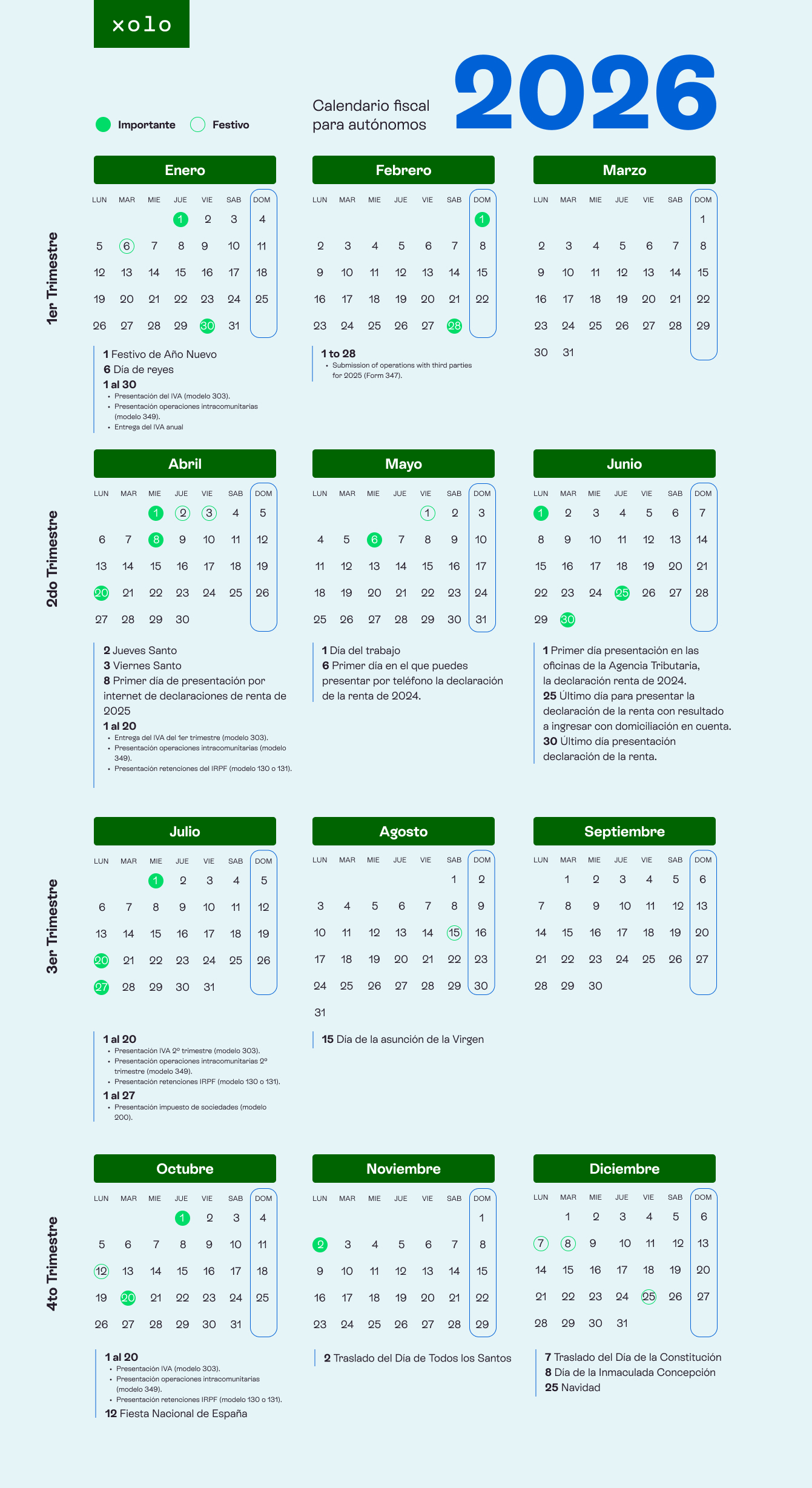
How is the Spanish fiscal year for autónomos structured?
The 2026 fiscal year follows the same quarterly structure as every other year:
- First quarter: 1 January – 31 March
- Second quarter: 1 April – 30 June
- Third quarter: 1 July – 30 September
- Fourth quarter: 1 October – 31 December
It doesn't matter if governments change, the Minister of Finance changes, or even - perhaps more importantly during tax season - the manager of Spain's national football team changes. The structure of the fiscal quarters remains exactly the same every year.
In fact, the only thing that may differ from one fiscal year to another is whether it's a leap year. In that case, February has 29 days instead of 28, giving the first quarter one additional day.
When do autónomos file VAT (IVA) in Spain in 2026?
For autónomos in Spain there are four different filing obligations:
- Quarterly IVA returns (Modelo 303)
- The annual IVA summary (Modelo 390)
- The annual declaration of transactions with third parties exceeding €3,005.06 (Modelo 347)
- Intra-Community transaction reporting (Modelo 349)
💡Read our comprehensive guide on IVA filings for autónomos here
Quarterly IVA filing deadlines for autónomos in 2026 (Modelo 303)
Modelo 303 is the form submitted to the Agencia Tributaria to declare and pay the quarterly IVA generated by your activity as an autónomo.
The filing schedule is as follows:
- 1–20 April: First-quarter IVA return
- 1–20 July: Second-quarter IVA return
- 1–20 October: Third-quarter IVA return
- 1–30 January: Fourth-quarter IVA return
The rule is straightforward. After each quarter ends, you'll generally have 20 calendar days to submit your Modelo 303.
The only exception is the fourth quarter, for which the Agencia Tributaria allows an extended filing period of 30 calendar days.
Annual IVA filing deadline for autónomos in 2026 (Modelo 390)
January is also the month when autónomos submit their annual IVA summary using Modelo 390.
The Agencia Tributaria allows taxpayers to file this return during the first 30 calendar days of January following the end of the tax year.
In other words, to submit the annual IVA summary for the 2026 fiscal year, you'll have from 1 to 30 January 2027. These are the same dates that apply to the fourth-quarter Modelo 303.
Filing the annual declaration of transactions with third parties (Modelo 347)
The Annual Declaration of Transactions with Third Parties (Modelo 347) is an informational return through which autónomos report transactions carried out with customers or suppliers whose total annual value exceeds €3,005.06.
As a general rule, this form must be submitted during February of the year following the tax year being declared, following the official calendar published by the Agencia Tributaria.
Not every autónomo is required to file Modelo 347. Whether the obligation applies depends on both the volume and the type of transactions carried out during the year.
How to file intra-Community transactions (Modelo 349)
If you carry out transactions with businesses or professionals in other European Union countries and have an intra-Community VAT number (ROI), you'll also need to submit Modelo 349.
This is an informational return used to report intra-Community transactions. There are two possible filing frequencies:
Monthly filing
The return must generally be submitted within 20 calendar days after the end of each month. For July and December, the filing period is extended to 30 days.
Quarterly filing
If you file quarterly, the deadlines are the same as those for quarterly IVA returns:
- 1–20 April: First quarter
- 1–20 July: Second quarter
- 1–20 October: Third quarter
- 1–30 January: Fourth quarter

When do autónomos pay IRPF in 2026?
In addition to the annual Income Tax Return, many autónomos are required to make quarterly advance payments. If you're taxed under the direct estimation (estimación directa) or objective estimation (estimación objetiva) regime, you may need to submit Modelo 130 or Modelo 131.
These forms allow you to pay part of your annual income tax throughout the year and follow the same schedule as the quarterly IVA returns.
The filing deadlines are:
- 1–20 April: First quarter
- 1–20 July: Second quarter
- 1–20 October: Third quarter
- 1–30 January: Fourth quarter
Filing deadlines for the annual Income Tax Return (Modelo 100)
In addition to the quarterly declarations, autónomos must also submit an annual Income Tax Return (Modelo 100). This is where your IRPF liability for the previous tax year is calculated and settled.
During the annual tax campaign, you can submit your return online, by phone or in person, following the official calendar published by the Agencia Tributaria.
For the 2025 tax year (filed in 2026), the key dates are:
- 8 April: Online filing opens.
- 6 May: Telephone filing begins.
- 1 June: In-person appointments at Agencia Tributaria offices begin.
- 25 June: Final day to submit a return with tax due if paying by direct debit.
- 30 June: Final day of the Income Tax campaign.
- 5 November: Deadline to pay the second instalment if you chose to split your tax payment.
Filing deadline for Corporate Tax (Impuesto sobre Sociedades)
Although most autónomos pay IRPF, those who operate through a company must instead file Corporate Tax (Modelo 200).
For companies whose financial year matches the calendar year, the standard filing period runs from: 1–25 July
💡 If you want learn more about how IRPF works, you can find a complete guide here.
Which tax forms does an autónomo need to file in Spain?
Depending on your business activity, tax regime and whether you carry out transactions within or outside Spain, you may not need to submit every tax form.
The most common tax forms are:
- Modelo 303: Quarterly IVA return.
- Modelo 390: Annual IVA summary.
- Modelo 130 or Modelo 131: Quarterly IRPF advance payments.
- Modelo 349: Intra-Community transactions.
- Modelo 347: Transactions with customers or suppliers exceeding €3,005.06 per year.
- Modelo 100: Annual Income Tax Return.
If you're unsure which tax forms apply to your situation, it's always advisable to consult a tax advisor. Your filing obligations depend on how your activity is registered and the type of business you carry out.
2026 month-by-month fiscal calendar for autónomos
Below you'll find a summary of the 2026 fiscal calendar for autónomos, including the main tax filing deadlines and the most relevant national public holidays.
This overview makes it easier to see your tax obligations at a glance and plan your year with greater confidence.
| Month | Key deadlines | Tax forms that may apply |
|---|---|---|
| January | Fourth-quarter IVA return, annual IVA summary and quarterly IRPF payments | 303, 390, 130/131, 349 |
| February | Annual declaration of transactions with third parties | 347 |
| April | First-quarter tax returns. Start of the Income Tax campaign | 303, 130/131, 349, 100 |
| May | Telephone Income Tax filing begins | 100 |
| June | In-person appointments begin. Deadline for direct debit payments and end of the Income Tax campaign | 100 |
| July | Second-quarter tax returns and Corporate Tax (if applicable) | 303, 130/131, 349, 200 |
| October | Third-quarter tax returns | 303, 130/131, 349 |
Main national public holidays in Spain in 2026*
- 1 January – New Year's Day
- 6 January – Epiphany (Three Kings' Day)
- 3 April – Good Friday
- 1 May – Labour Day
- 15 August – Assumption of Mary
- 12 October – National Day of Spain
- 1 November – All Saints' Day
- 6 December – Spanish Constitution Day
- 8 December – Immaculate Conception
- 25 December – Christmas Day
* Some public holidays may change or vary depending on your autonomous community and the official regional calendar for 2026. Be sure to check your local calendar to confirm which public holidays apply where you live.

FAQ about the 2026 fiscal calendar
Which taxes does an autónomo pay during the year?
The most common taxes for autónomos are IVA and IRPF. Depending on your business activity, you may also need to submit informational returns such as Modelo 347 or Modelo 349. If you operate through a company rather than as a sole trader, you'll generally need to file Corporate Tax (Impuesto sobre Sociedades) instead of IRPF.
What happens if I file a tax return late?
The Agencia Tributaria may apply surcharges, interest or penalties, depending on how late the return is submitted and whether there is tax to pay.
To avoid unnecessary costs, it's important to keep track of the fiscal calendar and submit each required tax form within the corresponding filing period.
Do all autónomos have to file the same tax forms?
No. The tax forms you need to submit depend on several factors, including:
- Your tax regime.
- The type of business activity you carry out.
- Whether you trade with businesses in other EU countries.
- Whether you're registered for IVA.
- Whether you operate as an autónomo or through a company.
Not every freelancer has the same reporting obligations.
Learn the calendar... or leave it to Xolo
Keeping track of tax deadlines is an important part of running a business—but it doesn't have to take up your time.
At Xolo, we help autónomos stay on top of their tax obligations in Spain. Our team takes care of your tax returns, reminds you about important deadlines and helps you remain compliant with the Agencia Tributaria, so you can spend more time focusing on your business.
With Xolo, you'll get:
- ✔️ VeriFactu-ready invoicing software, allowing you to create compliant invoices quickly and easily.
- ✔️ Registration as an autónomo with both the Agencia Tributaria and Seguridad Social.
- ✔️ Preparation and submission of your tax returns and declarations.
- ✔️ A dedicated team of experienced gestores who provide support in both Spanish and English and are available to answer your tax questions.