

.jpg?width=1200&height=100&name=Email_Items%20(1).jpg)
.png?width=63&height=63&name=Ellipse%20185%20(1).png)
|
✓ verified by Elena Garro
Accounting and Tax Specialist
|
|

So, you wanna be your own boss, huh? Good for you! Get ready for a bumpy ride full of number crunching, hours spent in government admin buildings, and trying to win over new clients. But hey, all the hassle will be worth it when you finally issue your first freelance invoice.
💡 Quick takeaway: Freelancers in Spain must issue legally compliant invoices that include specific client data, VAT (IVA), income tax (IRPF), sequential numbering, and correct legal wording—especially when invoicing EU or non-EU clients. Mistakes can delay payments or trigger tax issues.
Issuing your first freelance invoice is a milestone—but also a compliance checkpoint. Spanish tax authorities require invoices to follow strict formatting and tax rules, whether you work with Spanish, EU, or international clients. This guide explains exactly what to include on a Spanish freelance invoice, how VAT and IRPF work, when simplified invoices are allowed, and how electronic invoicing is becoming mandatory.
Key Spanish Invoicing Terms Every Freelancer Should Know
Knowing the lingo surrounding invoicing is pretty important for expat freelancers in Spain, so here’s a quick run-down of the most common words and phrases related to creating invoices.
- Agencia tributaria (aka AEAT, aka Hacienda) — The Spanish tax agency
- Autónomo — a freelancer
- Cuota de autónomo — Your monthly social security payment, or freelance quota
- Darse de alta (de autónomo) — Register (as a freelancer)
- Declaración trimestral — Your quarterly tax reports, which Xolo can take care of for you
- Factura — Invoice
- Funcionario — Any civil servant you encounter
- Gestor — An accountant
- Hacienda — The Spanish treasury department
- IRPF — This will appear on your sales invoices to another freelancers or companies in Spain
- IVA — Just like above, but for value-added tax (VAT)
- (La Declaración de) la Renta — Your tax return (submission). With a fiscal year from January to December, you should submit it between early April and late June.
- NIE — Your número de identidad de extranjero, or tax identification number for foreign workers in Spain
- Seguridad social — Social security. The payments you make for healthcare, your pension, and more.
What Exactly is a Freelance Invoice?
An invoice, according to Merriam-Webster… Hang on, we’re in Spain here, the Royal Spanish Academy (RAE) is our go-to resource.
Let’s start again.
According to the RAE, an invoice, or factura, is simply a bill that shows how much you're charging for your goods and services. If you’re a freelancer, or an autónomo, you’ll need to include a bunch of details or you won’t get paid 😲.
Now that we've got that straight, let's dive into the nitty-gritty. In this article, we’ll cover how to make your first freelance invoice, what information you need to include, and the format and structure you should follow.
How to Invoice as a Freelancer in Spain: the 21st-Century Edition
Wake up, campers! It's 2026 and we (well, most of us) aren’t living in the dark ages anymore. We've been through a pandemic, inflation is our new BFF, Messi finally brought home the World Cup, and the US and China have started a balloon-based cold war. Black Mirror, anyone?
Long story short, writing invoices with pen and paper and sending them by snail mail is so old school it’s about to enter history textbooks. These days, most invoices are made in PDF format and sent via email.
There's no one right way to make a freelance invoice. Some solos prefer to create their own invoice templates, others copy from their friends, and some even use invoicing software.
But in keeping with the times, more and more freelancers are using Xolo’s simple online solution. With just a few clicks of a button, you’ll get sleek, compliant invoices that don’t let anything fall through the cracks. Sign up now to see how easy creating a freelance invoice in Spain can be!
|
The best service for everyone, especially those who don’t have time to dive into the local tax system. Xolo does everything for you - tax reports, review your expenses, calculate your taxes and VAT, and help you on every step! The support is so lovely, will explain you anything with patience, step by step, with all the links so you don’t have to think when you do it 😁 Anastasia I.
|

What Must Be Included on a Full Freelance Invoice
While you have the freedom to choose your own invoice template, there's no leeway on the info you’ve got to include. Some things are simply non-negotiable if you want your invoice to be legit.
First and foremost, remember that you can only invoice for services or goods under the IAE category you're registered on with the Agencia Tributaria. If you plan to branch out and offer different services, make sure to register in the right category first.
Now, the required elements of an invoice will vary depending on the type of invoice you're making. But don't worry, we'll cover all the important details in the next section.
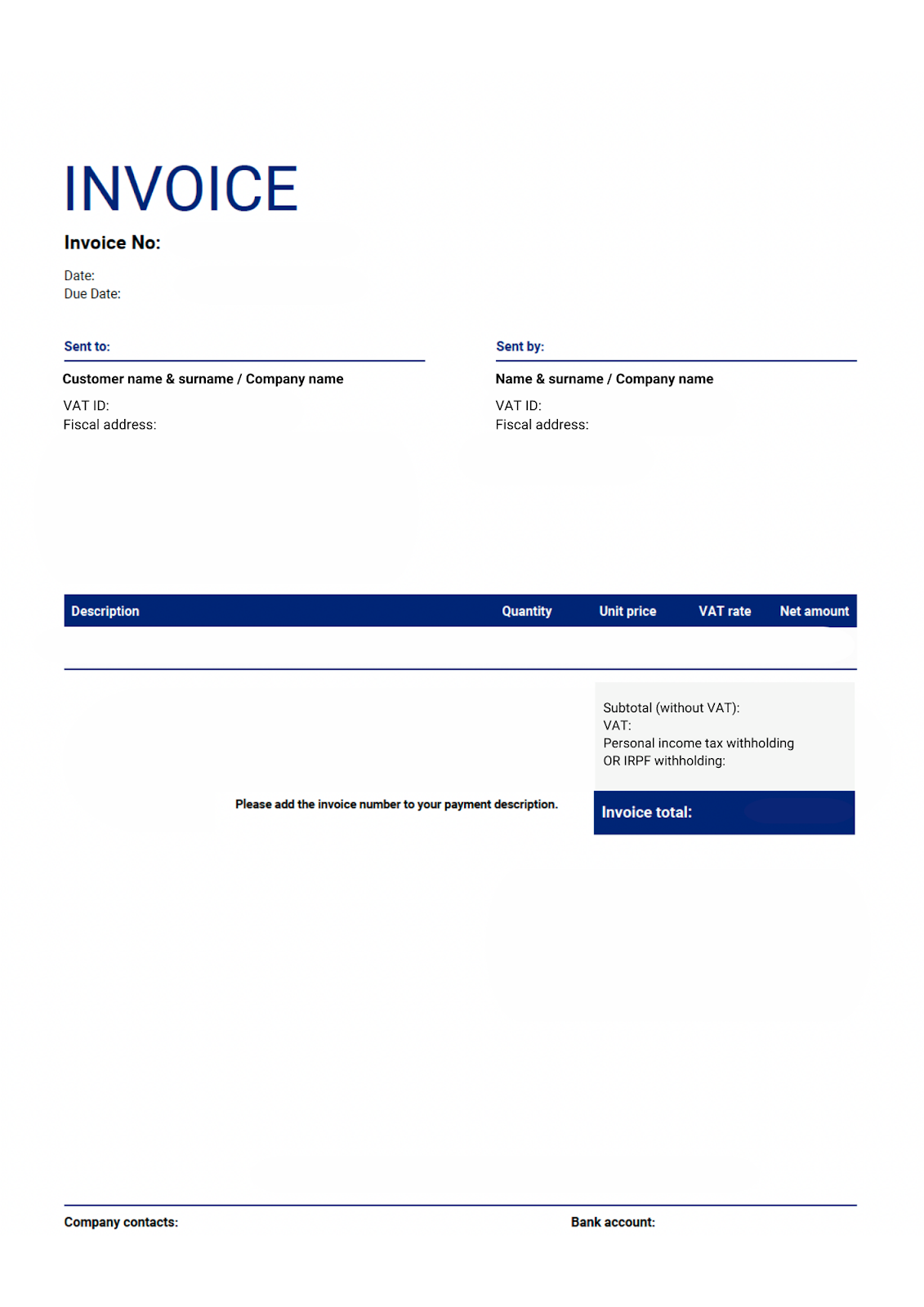
The full freelance invoice in Spain is the standard, go-to format unless you fall into one of the exceptions that we’ll see later. The mandatory information that must be included in the full invoice is:
- Name, surname (or full company name), and tax ID number — of both the issuer (you) and the recipient (your client).
- Address — both the issuer's and the recipient's addresses. Keep in mind that your fiscal address may not be the same as your home address 🏡.
- Issue date — the date you’re sending the invoice to the company or client you’re working with.
- The date(s) of your work and, if applicable, the date of prepayment — this is in case your operating and payment dates are different.
- Invoice number and series — freelancers have to have a consecutive numbering system for all invoices. Depending on the volume and diversity of your invoices, you can establish a separate series.
- For example, let's say you’re a freelancer who works as a web designer in the morning and a flamenco dancer at night. Stranger things have happened.
- The first invoice of the year for your web design work could be labeled "2023.A-1", the second, "2023.A-2", and so on.
- On the other hand, the invoice for your first flamenco performance on 1 January could be labeled "2023.B-1", while the performance on 7 January could use "2023.B-2", and so on.
- Don’t worry if that sounds too complex for your work. You can simply use a consecutive numbering system too, starting at 1.
- Description of your work — including the tasks you performed, the date you did them, any calculations such as your rate multiplied by hours, then the final amount for each task.
- Mention of who issued the invoice — You can create invoices in English. But the Spanish is either facturación por el destinatario if your recipient created the invoice, or facturación por el proveedor if it’s you.
- Mention of reverse charges — if applicable. That’s inversión del sujeto pasivo, in Spanish
- Mention of the special regime for travel agencies — if applicable: régimen especial de las agencias de viajes.
- Taxable amount, VAT rate, and (if applicable) withheld income tax — doctors or teachers may be exempt from VAT, as well as other professionals. If you’re invoicing foreign clients, this is a bit different, but we’ll cover that at the end of the article.
- Payable amount — the most important aspect, right?

Simplified Freelance Invoices: When Are They Allowed?
In 2013, the Agencia Tributaria relaxed the rules around simplified invoices. These invoices don't require the recipient's information because the recipient is a regular person, not a company. The simplified invoice was introduced as a more reliable alternative to traditional receipts as proof of payment. And as you might have guessed, simplified invoices are more streamlined than using a full invoice format.
There are, of course, certain conditions that must be met to use a simplified invoice:
- It cannot be a corrective invoice — more on that in the “other types of freelance invoices” section.
- The amount (including VAT) cannot exceed €400.
- The amount (including VAT) cannot exceed €3,000 for transactions listed below:
- Retail sales, both in-store and at the customer's home.
- Hotel, restaurant, dance hall, pub, and nightclub services, or food and/or beverages for immediate consumption or take-out.
- Transportation of people and luggage, including ambulance services.
- Highway tolls and parking fees.
- Use of sports facilities and services.
- Hairdressers, beauty salons, laundries, and dry cleaners.
- Photo studios.
- Movie rentals (are there any video stores left? I'm not sure...😕).
A simplified invoice must include the following information:
- Sequential numbering — (and different numbering for corrective invoices).
- Issue date.
- Transaction date — (or, if applicable, the date of advance payment received, provided it's different from the issue date).
- Issuer's NIF, name, surname, or company name.
- Description of goods provided or services rendered.
- Applied tax rate — and perhaps the phrase "VAT included" if applicable.
- Specification of any different VAT rates — if applicable.
- Total amount.
- If it's a corrective invoice, the original invoice number.
- If the recipient is a business person who requires a full invoice or a private individual who needs it for tax purposes, the issuer must also include the following information:
- Spanish NIF or ID number from another EU member state.
- Any tax liability to be charged.

Electronic Invoices in Spain (e-Invoicing)
As previously mentioned, paper invoices have become a thing of the past. Soon, even invoices generated in .pdf or .xls will also become obsolete.
Why? Because electronic invoices, which are better at preventing fraud, are going to take over.
Electronic invoices must include the same information as regular invoices, but they are issued electronically. Additionally, some electronic invoices may also have extra elements such as QR codes.
The newly introduced electronic invoices are already mandatory for any work for public organizations and in some Spanish regions, such as the Basque Country.
Other Types of Freelance Invoices
In addition to the three main types of invoices, there are a few others that are used less frequently.
Corrective Invoices (Rectificativas)
Everyone makes mistakes, even when it comes to invoicing your freelance clients. Fortunately, corrective invoices are there to help you fix any errors on previous invoices. You have up to four years to send a corrective invoice, so don't worry if you need to make any adjustments.
Summary Invoices
Going back to our flamenco dancer example 💃. Let's say in 2029 the economy is thriving, inflation is under control, and people all over Andalusia are partying non-stop. The Jerez Flamenco Festival is bouncing, and you’re on and off the stage like a yo-yo.
Instead of sending 20 separate invoices to the organizers, you could opt to send a summary invoice that includes all those jobs.
Proforma Invoices (Quotes)
If you're not familiar with the term "proforma invoice”, don't worry, you're not alone. But you might have heard of a “quote”. Same thing.
This type of invoice is simply a draft invoice that you send to your customer to provide pricing information for your services. It has no accounting value, and it is not taken into consideration for your tax reports, and doesn't bind you to any kind of commitment.

Your invoice-related duties as a freelancer
While invoicing is what brings in the dough, you’ve also got a few duties to fulfill if you want to stay in the Agencia Tributaria’s good books. First off, you need to keep track of the VAT you collect and the income tax withheld from your invoices, then report them to the tax authorities either quarterly and/or annually. While it may not be the most exciting aspect of freelance work, it's important to stay on top of these obligations to make sure you're compliant.
VAT & IRPF on Spanish Freelance Invoices
VAT and personal income tax. Two peas in a pod who love popping up all over freelance life.
VAT (IVA) Rates
Although some activities are exempt from VAT, almost all invoices to Spanish clients need to include value-added tax. Although the standard rate is 21%, the applicable amount could be 4% or 10%, depending on the activity.
IRPF Withholding
For freelancers, the standard income tax rate is 15%. There is a reduced rate of 7% for your first year as a freelancer in Spain, but in both cases, you have to balance your books with your annual tax return.
Cross-Border Invoices
Now that you are familiar with the basics of invoicing, it's time to explore different types of invoices according to the country you and your clients are based in. For all of the following cases, we’ll assume you’re living and working in Spain.
🇪🇸 How to issue invoices within Spain
These invoices are issued within Spain and have three potential recipients:
- For private customers: TAXABLE AMOUNT + VAT = TOTAL PAYABLE
- For a company or customers in a professional capacity: TAXABLE AMOUNT + VAT - WITHHELD INCOME TAX (if applicable) = TOTAL PAYABLE
- For a VAT-exempt activity (such as teaching or): TAXABLE AMOUNT - WITHHELD INCOME TAX (if applicable) = TOTAL PAYABLE. If the invoice goes to a private person: TAXABLE AMOUNT = TOTAL PAYABLE
In the latter case, the following statement must be added:
"Invoice exempt from VAT in accordance with article 20.1, section 102 of the VAT Law 37/1992".
Or in Spanish…
“Factura exenta de IVA de acuerdo con artículo 20.uno, apartado 102 de la Ley 37/1992 del IVA”
🇪🇺 How to issue invoices to non-Spanish EU clients
So-called intra-community invoices are those issued outside of Spain but within the European Union. Both the issuer and the client must be registered in the ROI (Register of Intra-Community Operators), which you can check here. If not, and you’re the issuer, you have to create your invoice with Spanish VAT, including “nacional de servicios” in the description of your work.
You can also create intra-community invoices in three ways:
- For private customers: TAXABLE AMOUNT + VAT = TOTAL PAYABLE
- For a business or professional customer NOT registered in the ROI: TAXABLE AMOUNT + VAT = TOTAL PAYABLE
- For a business or professional client registered in the ROI: TAXABLE AMOUNT = TOTAL PAYABLE.
In the last case, add the following text:
"Invoice exempt from VAT pursuant to Directive 2006/112/EC and art. 25 of VAT Law 37/1992".
Here’s the Spanish again.
“Factura exenta de IVA por aplicación de la Directiva 2006/112/CE y el art. 25 de la Ley 37/1992 del IVA".
🌏 How to issue invoices to foreign, non-EU clients
So how do you deal with your clients from Singapore, the USA, and (sorry) the UK? Without being in the same country as your clients, or having an ROI-style agreement, you have to manage VAT differently, as we’ll see.
You can create your non-EU invoices in three ways:
- For a service rendered to a private customer: TAXABLE AMOUNT + VAT = TOTAL PAYABLE
- For a sale of goods to a private customer: (e.g. an export where the VAT is paid by the consignee at customs): TAXABLE AMOUNT = TOTAL PAYABLE
- For a business or professional client (or for an individual for certain services such as advertising, consulting, auditing, engineering, legal consulting, tax accounting, translation, proofreading, interpreting, or film dubbing): TAXABLE AMOUNT = TOTAL PAYABLE.
In this final case, the recipient's tax ID number must be added along with the line:
"Transaction not subject to localization rules by virtue of art. 69 of Law 37/1992 on VAT".
And in Spanish:
“Operación no sujeta por normas de localización en virtud del art. 69 de la Ley 37/1992, del IVA.”
How to Deal With Unpaid Invoices
Dealing with unpaid invoices can be a headache for freelancers in Spain and all over the world. Unfortunately, there’s not much you can do beyond hiring a debt collector. However, it is possible to recover the VAT included in the invoice if certain conditions are met:
- The invoice must be registered as issued with the Agencia Tributaria.
- The recipient of the invoice must be a business or professional individual. Or if not, the amount of the invoice must exceed €300 at the taxable base level.
- Six months must have passed since the payment due date.
- Payment must have been requested by a judicial claim or notarial demand.
If you check all those boxes, you can issue a corrective invoice and get the VAT back. It ain't much, but hey, every little helps.
Can I Edit or Delete an Already-Issued Invoice?
So, you know that feeling when you send the wrong invoice and don’t quite hit “undo” in time? Yeah, we've all been there. If it’s to a client, you can kindly ask them to destroy it in a skip fire while you send the right one or inform them that you are going to send them a rectification invoice and a new and correct one
Sadly though, once you've sent it off to the tax authorities, there's no going back.
But there is hope! You can create a corrective invoice. It's like canceling out the original one and starting over.
Where to Get a Spanish Freelance Invoice Template
Issuing compliant freelance invoices in Spain is not optional—it’s a legal requirement that affects your taxes, payments, and long-term business security. By including the correct details, applying VAT and IRPF properly, and using the right invoice type for each situation, freelancers can avoid penalties and get paid faster.
👉 Xolo Spain simplifies everything—from free autónomo registration to VAT-correct, electronic invoices and quarterly tax filings.
Invoice like a pro and let Xolo handle the admin.
Come say hi 👋 and find out how much Xolo can reduce your admin hours.