---
title: AI-powered Expense Management for Freelancers in Italy
description: Learn how AI-powered expense management helps freelancers in regime forfettario or semplificata stay organised and compliant –– simple solutions with zero mess
image: https://blog.xolo.io/hubfs/Global_Blog_07_23_Library_Header_1280x854_25.jpg
---
[Xolo](https://www.xolo.io/it-it)
- Servizi
- Servizi Xolo Italia
- [Soluzione tutto-in-uno](https://www.xolo.io/it-it)
- [Apertura Partita IVA](https://www.xolo.io/it-it/vat-registration)
- [Contabilità](https://www.xolo.io/it-it/accounting)
- [Fatturazione](https://www.xolo.io/it-it/invoicing)
- [Dichiarazione dei redditi](https://www.xolo.io/it-it/tax-return)
- Altre soluzioni
- [Xolo Spagna — Per autónomos in Spagna](https://www.xolo.io/es-es)
- [Xolo Leap — Società UE con e-Residency](https://www.xolo.io/zz-it/leap)
- [Xolo Go — Fatturazione senza società](https://www.xolo.io/zz-it/go)
- Risorse
- [Calcolatore tasse regime forfettario](https://www.xolo.io/it-it/calcolatore)
- [Guide per liberi professionisti](https://blog.xolo.io/it)
- [Ricerca codice ATECO](https://www.xolo.io/it-it/codice-ateco)
- [FAQs](https://www.xolo.io/it-it/faq/xolo-italy/category/inizia-con-xolo)
- [Prezzi](https://www.xolo.io/it-it/pricing)
- [Freelance in Italia](https://www.xolo.io/it-it/freelancer-in-italia)
- [Su Xolo](https://www.xolo.io/it-it/about)
- [Accesso](https://app.xolo.io/hub/login?locale=it-it)
- [Inizia](https://app.xolo.io/signup/account?plan=LEAP_ITA_BASIC&locale=it-it)
[Inizia](https://app.xolo.io/signup/account?plan=LEAP_ITA_BASIC&locale=it-it)
- [Pagina iniziale](https://www.xolo.io/it-it)
- Servizi
- Risorse
- [Prezzi](https://www.xolo.io/it-it/pricing)
- [Freelance in Italia](https://www.xolo.io/it-it/freelancer-in-italia)
- [Su Xolo](https://www.xolo.io/it-it/about)
- [Accesso](https://app.xolo.io/hub/login?locale=it-it)
- Main menu
- Servizi Xolo Italia
- [Soluzione tutto-in-uno](https://www.xolo.io/it-it)
- [Apertura Partita IVA](https://www.xolo.io/it-it/vat-registration)
- [Contabilità](https://www.xolo.io/it-it/accounting)
- [Fatturazione](https://www.xolo.io/it-it/invoicing)
- [Dichiarazione dei redditi](https://www.xolo.io/it-it/tax-return)
- Altre soluzioni
- [Xolo Spagna — Per autónomos in Spagna](https://www.xolo.io/es-es)
- [Xolo Leap — Società UE con e-Residency](https://www.xolo.io/zz-it/leap)
- [Xolo Go — Fatturazione senza società](https://www.xolo.io/zz-it/go)
- Main menu
- [Calcolatore tasse regime forfettario](https://www.xolo.io/it-it/calcolatore)
- [Guide per liberi professionisti](https://blog.xolo.io/it)
- [Ricerca codice ATECO](https://www.xolo.io/it-it/codice-ateco)
- [FAQs](https://www.xolo.io/it-it/faq/xolo-italy/category/inizia-con-xolo)
[Tutti gli articoli](https://blog.xolo.io/it)
# AI-powered Expense Management for Freelancers in Italy

Autore [Xolo](https://blog.xolo.io/it/author/xolo)
Scritto da 17 marzo, 2026• **5 minuti di lettura**

Freelancers in Italy thrive on independence, but administrative tasks like expense managementcan turn independence into chaos if left unchecked.
Even if invoices pass through Italy’s Sdl system electronically, offline expenses are still commonplace. These documents don’t auto-organize or find themselves reported in a big \*poof!\* of magic smoke. And finding receipts when you need them down the road? That’s where magic may actually be needed.
**Xolo’s AI-powered expense management tool was built for freelancers in Italy.** And we’re certain this simple way to collect, organise and automate the preparation of expense documents will change your perception on admin.
So let’s get down to business and explain:
- Why expense documentation matters in Italy
- How different freelance regimes treat expenses
- How automated expense management simplifies your accounting
- How to set up a simple workflow that saves hours every month
## **Why does expense documenting matter for freelancers in Italy?**
Expense documenting puts money back in your pocket, and doing it right protects your business.
For an expense to be valid from a tax perspective, two things must generally be true:
1. Proper documentation exists (invoice, receipt, or equivalent proof);
2. The expense is related to your business activity (what accountants call *inerenza*)
A bank transaction alone only proves that money moved. It does not show what you bought, whether the purchase was business-related, or whether supporting documentation exists.
And keeping documents isn’t just a short-term task.
Under Italian law, accounting records and invoices are typically expected to be kept for 10 years (Civil Code, art. 2220). Tax authorities also have several years to review filings, meaning documentation may be required long after the expense happened.
## **How does expense management work across Italian freelance regimes?**
Not all freelancers in Italy are taxed the same way.
Operating under regime forfettario, or contabilità semplificata**,** will change how expenses impact your taxes. Knowing the difference is important.
But even if expenses don’t directly reduce taxes, organising them still matters for several reasons.
- **Get visibility on your true business costs**.
Travel, tools, subscriptions and client expenses can add up quietly in the background –– having everything stored centrally will help you understand your profitability.
- **Prepare better for the future.**
When your business grows and you move into another accounting regime (or register an official company), organised expense documentation will be essential.
- **Simplified daily operations.**
Recharging costs to a client? Verifying a purchase? Retrieve the document you need in seconds rather than hiring a private investigator to discover where it vanished off to.
- **Compliant international costs**
Freelancers often purchase services from EU and non-EU suppliers alike (things like software subscriptions and advertising platforms). These may fall under the reverse charge mechanism, requiring you to have proper documentation in order.
### **Regime Forfettario**
In the regime forfettario, taxable income is calculated using a profitability coefficient rather than actual costs. This means most expenses do not directly reduce your income tax base.
👉 If you want to understand this system in detail, [check out our guide to the Italian regime forfettario](https://blog.xolo.io/essential-guide-to-the-italian-regime-forfettario).
Expenses may not always lower your taxable amounts, but proper documentation will keep your stress levels down and improve your ability to make quality business decisions.
### **Contabilità Semplificata**
If you operate under contabilità semplificata, costs can directly affect taxable income.
This means that missing documents may translate into deductions you cannot safely claim. It’s also where freelancers encounter real-world complexity. Not all expenses arrive neatly through official systems. You might receive:
- PDFs from suppliers
- Photos of receipts
- Scanned documents
- Foreign invoices from digital platforms
Keeping these organised ensures your accountant can review and process them correctly.
## **SdI vs real-world expenses: Where the chaos begins**
Italy’s SdI (Sistema di Interscambio) digitises many invoices automatically. These structured e-invoices are easy to process and already integrated into accounting workflows. A breath of fresh air.
Yet, freelancers still deal with many expenses that do not pass through SdI:
- Software subscriptions from foreign providers
- Restaurant or travel receipts
- Coworking invoices
- Scanned or photographed documents
And that’s just to name a few! These are the documents that create administrative work and last-minute stress –– especially when forgotten until much, much later.
Xolo’s automated expense management feature is designed to close that gap, so let’s dig right into the ‘How?’
## **How Xolo’s AI-Powered Expense Management Works**
Xolo allows freelancers all throughout Italy to upload expense documents on-the-go, monthly, or whenever you see fit.
A simple, yet powerful, tool for automated expense management with a couple different options for secure uploading –– create a basic habit, and never miss an expense.
### **How to upload expenses to your Xolo account**
One system that works for most freelancers takes about five minutes:
1. Save your Xolo expense upload email as a contact
2. Create an email rule that automatically forwards invoices from recurring vendors
3. Upload remaining receipts once per week or once per month
#### **Forward expenses by email**
Your Xolo account will have its own dedicated expense-upload email address that you can utilize at any time (without logging in, and from any device). This will enable you to:
- Forward invoices you receive by email
- Share the address with recurring vendors (like coworking spaces or software providers)
Invoices will automatically arrive in your accounting environment with Xolo’s professionals, no manual downloads required –– snap a quick photo of a receipt after dinner and you’re good to go.
#### **Upload documents via your expense dashboard**
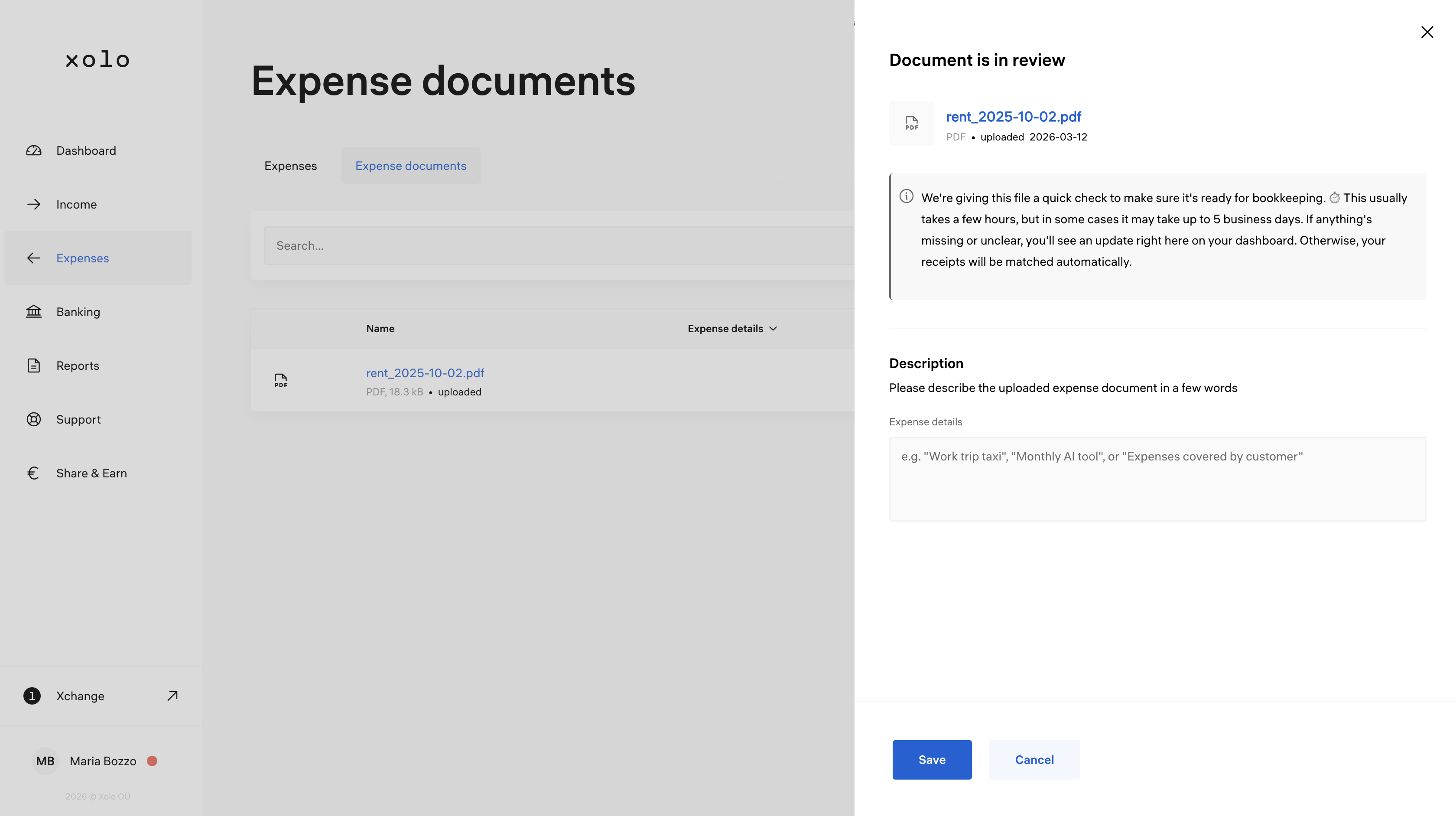
Basic enough, and for those who may be doing things in bulk or from a single device, you can easily upload any expense-related documents directly in the Expenses section of your Xolo account’s dashboard.
Anything from PDFs and scans, to .jpegs and mobile photos of receipts.
### **What does Xolo do after you upload an expense?**
Any document entering your Xolo accounting database will be automatically reviewed and key data will be extracted. Information such as supplier name, dates, amounts and VAT (if needed) will be pulled instantaneously.
Everything is then organised for accounting workflows and monthly reports.
Xolo’s professional team of accountants review any documents where information is unclear (common with physical documentation like receipts) to ensure accurate bookkeeping.
## **Good admin matters when freelancing in Italy**
You want to deliver amazing work to clients, and spend your time dialed-in to the work that brings you joy.
We get that from the bottom of our freelance-forward hearts. Being able to focus on that aspect of your growing business means you’ll need to properly manage compliance, taxes and documentation –– it cannot be skipped, but it can be simplified.
When your business grows, having systems like automated expense management will be a monumental advantage. Keep your accounting clean, so you can focus on the real business at hand.
👉We’ve got a [full guide to becoming (and working) as a freelancer in Italy](https://blog.xolo.io/guide-to-becoming-and-working-as-a-freelancer-in-italy) if you’re curious.
## **Get it done, with Xolo Commercialista in Italy**
Do not make expense management and other admin tasks your second or third job. With Xolo’s AI-powered expense management, built uniquely for freelancers in Italy, you can:
- Collect receipts effortlessly
- Organise documents automatically
- Stay compliant with Italian tax rules
- Keep your accounting stress-free
Upload expenses as they happen and let Xolo handle the rest.
👉 [Explore Xolo](https://www.xolo.io/it-en) for freelancers in Italy
## **FAQ: quick answers for freelancers in Italy**
**Link to public FAQs here:**
- [How the Simplified Regime works and why expenses matter](https://www.xolo.io/it-en/faq/xolo-italy/category/simplified-regime/subcategory/general-information)
- [Deductible expenses in Simplified Regime](https://www.xolo.io/it-en/faq/xolo-italy/category/simplified-regime/subcategory/expenses-in-simplified-regime)
**Q: Do I need to keep expense receipts in regime forfettario?**Even if your costs do not reduce taxable income the same way as in non-forfettario regimes, keeping and being able to retrieve supporting documents is still smart risk management — especially for proving business relevance and maintaining orderly records.
**Q: How long should I keep invoices and accounting documents?**A common legal baseline is **10 years** (Civil Code art. 2220).
**Q: Does everything arrive via SdI?**Many invoices do: Remember to provide the right SDI code to your suppliers, so Xolo can review their electronic invoices for you automatically: M5UXCR1. However, plenty of real-life expenses can still show up as PDFs, receipts, scans, photos, or foreign supplier documents. Those “everything else” items are usually where the manual work comes from.
**Q: How long can the tax authority assess my filings?**As a baseline: up to **31 December of the fifth year** after filing, and up to **the seventh year** in cases like omitted or null returns (DPR 600/1973 art. 43).
### Automate you expenses
[Join Xolo today](https://www.xolo.io/it-en)
[For Expats](https://blog.xolo.io/it/topic/for-expats)
## Articoli correlati
## Iscriviti alla nostra newsletter
Ricevi tutte le ultime notizie e consigli per vivere una vita da freelancer equilibrata direttamente sulla tua email.
### Iscriviti alla nostra Newsletter
**Xolo**
- [Chi siamo](https://www.xolo.io/it-it/about)
- [Informativa sulla privacy](https://www.xolo.io/it-it/privacy)
- [Termini e condizioni](https://www.xolo.io/it-it/terms)
- [Lavora con noi](https://www.xolo.io/zz-en/careers)
- [Stampa](https://www.xolo.io/it-it/press)
- [Xolo Spagna](https://www.xolo.io/es-es)
- [Xolo Leap](https://www.xolo.io/zz-it/leap)
- [Xolo Go](https://www.xolo.io/zz-it/go)
**Servizi**
- [Soluzione tutto-in-uno](https://www.xolo.io/it-it)
- [Apertura Partita IVA](https://www.xolo.io/it-it/vat-registration)
- [Contabilità](https://www.xolo.io/it-it/accounting)
- [Fatturazione](https://www.xolo.io/it-it/invoicing)
- [Dichiarazione dei redditi](https://www.xolo.io/it-it/tax-return)
- [Per professionisti internazionali](https://www.xolo.io/it-it/freelancer-in-italia)
**Risorse**
- [Aiuto](https://www.xolo.io/it-it/faq/xolo-italy)
- [Prezzi](https://www.xolo.io/it-it/pricing)
- [Calcolatore tasse regime forfettario](https://www.xolo.io/it-it/calcolatore)
- [Ricerca codice ATECO](https://www.xolo.io/it-it/codice-ateco)
- [Guide per liberi professionisti](https://blog.xolo.io/it)
---
Xolo Italia S.r.l. | Via Tortona, 33 - 20144 Milano | C.F. e P.IVA: 12134920961