---
title: "Spain Freelance Tax Deadlines 2026: Full Calendar"
description: "Freelancer tax calendar Spain: VAT, IRPF & key deadlines explained. Stay compliant and avoid fines with this simple 2026 guide."
image: https://blog.xolo.io/hubfs/Xolo_Global_Genric_Blog_image_1280x854-7.webp
---
[📣 Manage invoices, expenses & taxes effortlessly with the new Lite plan only for €15/month! Try it now →](https://app.xolo.io/signup/account?plan=LEAP_ESP_LITE&locale=es-en)
[Xolo](https://www.xolo.io/es-en)
- Services
- [All-in-one solution](https://www.xolo.io/es-en)
- [Invoicing](https://www.xolo.io/es-en/invoicing)
- [Expense management](https://www.xolo.io/es-en/expense-management)
- [Accountants](https://www.xolo.io/es-en/accountants)
- [Tax Forecast](https://www.xolo.io/es-en/tax-forecast)
- [Self-serve Accounting](https://www.xolo.io/es-en/self-serve-accounting)
- [E-commerce accounting](https://www.xolo.io/es-en/e-commerce-accounting)
- [Additional Services](https://www.xolo.io/es-en/additional-services)
- [Autónomo Registration](https://www.xolo.io/es-en/autonomo-registration)
- [Renta](https://www.xolo.io/es-en/renta)
- [Insurance](https://www.xolo.io/es-en/insurance)
- [Annual tax reports](https://www.xolo.io/es-en/annual-tax-report)
- Other solutions
- [Xolo Leap — EU company via e-Residency](https://www.xolo.io/zz-en/leap)
- [Xolo Go — Invoice without a company](https://www.xolo.io/zz-en/go)
- [Xolo Italy — Manage your Partita IVA](https://www.xolo.io/it-en)
- Resources
- [Net salary calculator](https://www.xolo.io/es-en/calculadora-sueldo-neto-autonomo)
- [Freelancer quota calculator](https://www.xolo.io/es-en/calculadora-cuota-autonomos)
- [Onboarding guide](https://guides.xolo.io/es-en)
- [Blog](https://blog.xolo.io/es-us)
- [FAQs](https://www.xolo.io/es-en/faq/xolo-spain)
- [Pricing](https://www.xolo.io/es-en/pricing)
- [About us](https://www.xolo.io/es-en/about)
- [Login](https://app.xolo.io/hub/login?locale=es-en)
- [Sign up](https://app.xolo.io/signup/account?plan=LEAP_ESP_LITE&locale=es-en)
- EN
- [ES](https://blog.xolo.io/es)
- [EN](https://blog.xolo.io/es-us)
[Sign up](https://app.xolo.io/signup/account?plan=LEAP_ESP_LITE&locale=es-en)
- [Home](https://www.xolo.io/es-en)
- Services
- Resources
- [Pricing](https://www.xolo.io/es-en/pricing)
- [About Us](https://www.xolo.io/es-en/about)
- Main menu
- All-in-one solution
- [Invoicing](https://www.xolo.io/es-en/invoicing)
- [Expense management](https://www.xolo.io/es-en/expense-management)
- [Accountants](https://www.xolo.io/es-en/accountants)
- [Tax Forecast](https://www.xolo.io/es-en/tax-forecast)
- [Self-serve Accounting](https://www.xolo.io/es-en/self-serve-accounting)
- [E-commerce accounting](https://www.xolo.io/es-en/e-commerce-accounting)
- Additional Services
- [Autónomo Registration](https://www.xolo.io/es-en/autonomo-registration)
- [Renta](https://www.xolo.io/es-en/renta)
- [Insurance](https://www.xolo.io/es-en/insurance)
- [Annual tax reports](https://www.xolo.io/es-en/annual-tax-report)
- Other solutions
- [Xolo Leap — EU company via e-Residency](https://www.xolo.io/zz-en/leap)
- [Xolo Go — Invoice without a company](https://www.xolo.io/zz-en/go)
- [Xolo Italy — Manage your Partita IVA](https://www.xolo.io/it-en)
- Back to top
- [Login](https://app.xolo.io/hub/login?locale=es-en)
- Main menu
- [Net salary calculator](https://www.xolo.io/es-en/calculadora-sueldo-neto-autonomo)
- [Freelancer quota calculator](https://www.xolo.io/es-en/calculadora-cuota-autonomos)
- [Onboarding guide](https://guides.xolo.io/es-en)
- [Blog](https://blog.xolo.io/es-us)
- [FAQs](https://www.xolo.io/es-en/faq/xolo-spain)
- [Login](https://app.xolo.io/hub/login?locale=es-en)
- **EN**
- Main menu
- [ES](https://blog.xolo.io/es)
- [EN](https://blog.xolo.io/es-us)
[Back to the articles](https://blog.xolo.io/es-us)
# Spain Freelance Tax Deadlines 2026: Full Calendar

Written by [Xolo](https://blog.xolo.io/es-us/author/xolo)
on abril 11, 2026 • **4 min of reading**

Ah, calendars! The nostalgic memories of those paper calendars hanging on the kitchen wall! It's a form of art that's getting lost in the era of Google Calendar. Each person had a different one. Music lovers? A calendar with all the concerts in the city. Football fans? One for the 1998 France World Cup matches. And for freelancers? Well, we had a sadder one: the tax calendar, marking all the tax filing dates and more.
# **What taxes do freelancers need to file in Spain—and when?**
If you're self-employed (autónomo) in Spain, staying on top of tax deadlines is critical to avoid fines and stress. The good news? The freelance tax calendar follows a predictable quarterly system.
**Quick takeaway:**
- Freelancers file taxes **every quarter (VAT + IRPF)**
- Key deadlines fall in **April, July, October, and January**
- Missing deadlines can result in **penalties and surcharges**
This guide breaks down the **Spain freelancer tax calendar**, including VAT (Modelo 303), IRPF, and key annual filings—so you never miss a deadline again.
## What Is the Freelance Tax Calendar in Spain?
The freelance tax calendar in Spain is a structured schedule that determines when autónomos must file taxes such as VAT (IVA), income tax (IRPF), and other declarations.
**Why it matters:** Missing deadlines can lead to penalties, while staying compliant ensures smooth business operations.
## How the Freelance Tax Year Is Structured (Quarterly System)
Let's start with the simple part, something anyone who's been a freelancer for a while will perfectly understand: how the fiscal year for self-employed workers is structured.
No surprises here: the fiscal quarters for freelancers are set based on the usual dates:
- 1st quarter: January 1 - March 31.
- 2nd quarter: April 1 - June 30.
- 3rd quarter: July 1 - September 30.
- 4th quarter: October 1 - December 31.
Regardless of changes in the government, the Finance Minister, or even more importantly around these dates, the Spanish football coach: this organization of the quarters never changes and remains fixed.
In fact, the only thing that might change from one fiscal year to another is if the year is a leap year, making February have 29 days instead of 28, and consequently, giving the first quarter one more business day.
(And speaking of having a tough time—imagine the problems of being born on February 29, right? Like being a preteen prime minister. Because Pedro Sánchez, born on February 29, 1972, will turn fifteen in 2026. And there you see him, the little guy, mingling with Joe Biden. Life.)
[](https://cta-redirect.hubspot.com/cta/redirect/5615817/c4ac696a-352d-481f-b30c-58fef04b9018)
## 2026 VAT Calendar for Freelancers
If you've read our comprehensive, knowledgeable article about [VAT for freelancers](https://guides.xolo.io/es-en/vat-for-freelancers-in-spain-a-step-by-step-guide)here at Xolo, you probably know all you need to. But, just in case, let's go over the VAT filing schedule again for freelancers in 2026.
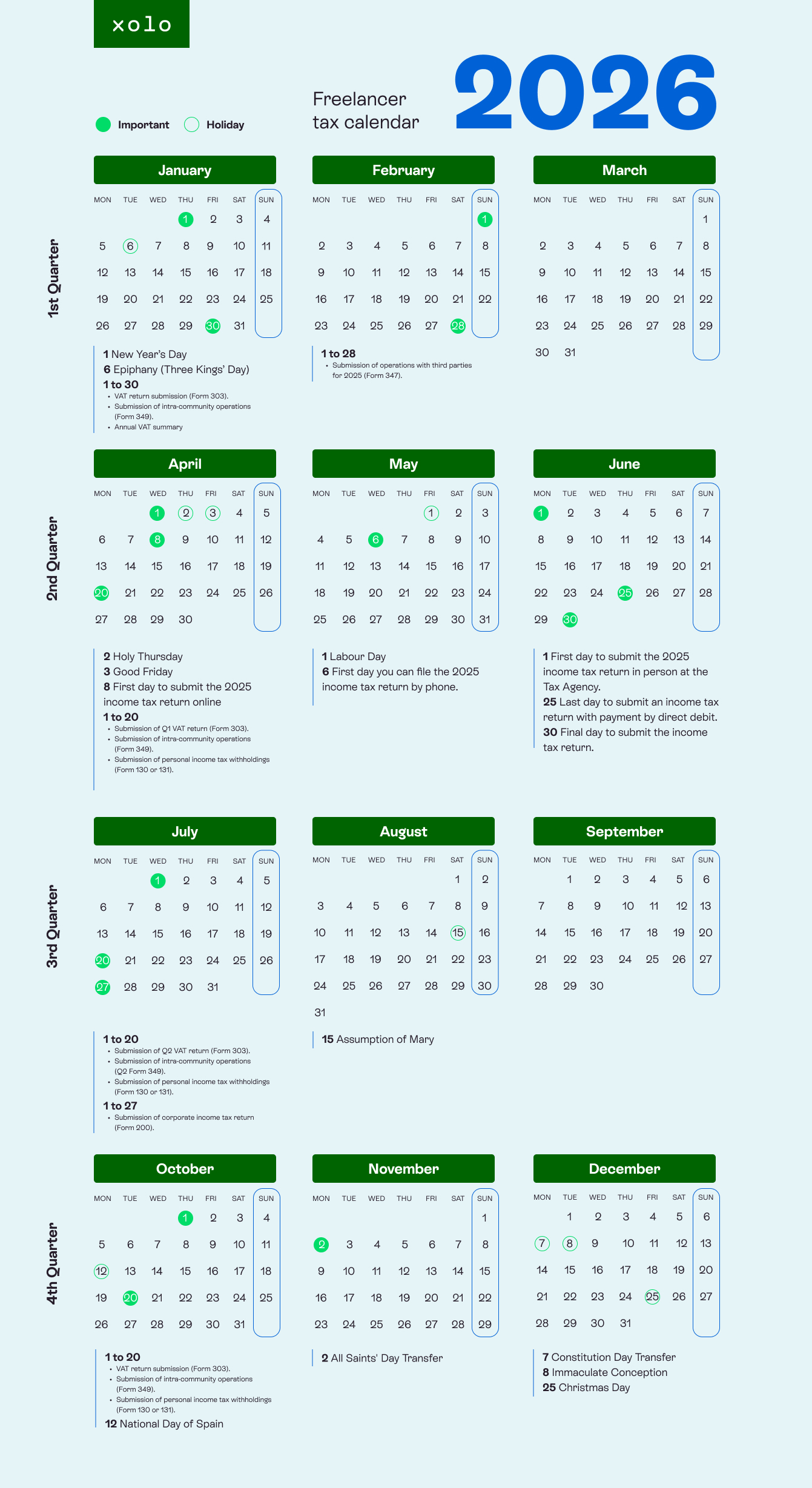
We'll divide the filings into four: the quarterly VAT filings (using form 303), the annual VAT (form 390), filings for operations with clients over 3005.06 euros (form 347), and the intracommunity operations filings (form 349).
### Quarterly VAT Filing Dates for Freelancers in 2026: Form 303
- April 1-22: Q1 VAT filing.
- July 1-22: Q2 VAT filing.
- October 1-21: Q3 VAT filing.
- January 1-30: Q4 VAT filing.
The rule is clear: after the end of each quarter, you have 20 calendar days to submit your form 303. The only variation is for the Q4 VAT filing, for which the Tax Office gives a 30-day period, likely to account for the holiday season and to harmonize filings.
### [Discover how Xolo can simplify your freelance business in Spain.](https://www.xolo.io/es-en)[Explore Xolo today and take the first step towards smarter financial management!](https://www.xolo.io/es-en)
### Annual VAT Filing for Freelancers: Form 390
- You have the first 30 natural days of January to submit the annual VAT for the previous fiscal year, aligning with the Q4 VAT filing dates.
### Filing of Operations with Third Parties: Form 347
- This annual report, detailing operations with third parties over 3005.06 euros, needs to be filed between February 1-28.
### Intracommunity Operations Filing: Form 349
- This can be done monthly, within 20 days after the end of each month, except in July and December, when you have 30 days. Alternatively, it aligns with the quarterly VAT filing dates.
[](https://cta-redirect.hubspot.com/cta/redirect/5615817/48efb5fb-f362-4abf-8785-41355bf47d02)
## IRPF and Corporate Tax Filing Dates
Lastly, let's look at the two most significant taxes apart from VAT: Personal Income Tax (IRPF) and Corporate Tax.
### Quarterly IRPF Retentions Filing Dates
- Same as the quarterly VAT dates.
### Annual IRPF Declaration
- Begins April 3 for internet filings, with various other key dates leading up to in-person filings starting June 3 and concluding by June 26 if payment is due, with the campaign wrapping up on July 1.
### Corporate Tax Filing
- If a company's fiscal year ends on December 31, the Corporate Tax, through forms 200 and 220, must be filed between July 1-25.
We've put all this information together in a more philosophical manner here at Xolo. We've balanced the bad news (tax dates) with good news (holidays). So study this calendar—or leave it to us at Xolo, and let our team handle your quarterly filings and other freelance administrative tasks with our proprietary billing program and a team of accountants to ensure correct tax filings.
## Common Freelancer Tax Mistakes to Avoid
- Missing quarterly deadlines
- Forgetting annual filings (Modelo 390, IRPF)
- Not tracking client thresholds (Modelo 347)
- Ignoring intracommunity obligations
👉 These are the most common reasons freelancers face fines.
## About Xolo
The freelance tax calendar in Spain follows a predictable quarterly system—but staying compliant requires consistency and organization.
From VAT filings (Modelo 303) to income tax (IRPF), understanding your deadlines helps you avoid penalties and run a smoother business.
👉 With Xolo, you don’t need to track every deadline manually. We handle your invoicing, taxes, and compliance—so you can focus on growing your freelance business in Spain.
[](https://cta-redirect.hubspot.com/cta/redirect/5615817/4d1cb0fa-ce10-4689-936d-e233af9fcb02)
## FAQ
### Q: When do freelancers pay taxes in Spain?
Freelancers pay taxes quarterly—typically in April, July, October, and January.
### Q: What is Modelo 303?
Modelo 303 is the quarterly VAT return that freelancers in Spain must submit.
### Q: What happens if you miss a tax deadline in Spain?
You may face penalties, surcharges, and interest—even if no tax is owed.
### Q: Do freelancers need to file taxes every month?
Usually no—most file quarterly, except for specific cases like intracommunity operations.
### Q: What is Modelo 390?
Modelo 390 is the annual VAT summary filed in January.
## Table of contents
### Get the support you need to run your business in Spain - with English-speaking support 🥇
[Explore Xolo](https://www.xolo.io/es-en?bcta=sticky-es-en-spain)
[Freelance](https://blog.xolo.io/es-us/topic/freelance) [Xolo](https://blog.xolo.io/es-us/topic/xolo)
## Related articles
**Xolo**
- [About](https://www.xolo.io/es-en/about)
- [Our plans](https://www.xolo.io/es-en/pricing)
- [Careers](https://www.xolo.io/zz-en/careers)
- [Contact](https://www.xolo.io/es-en/about#section-about)
**Services**
- [All-in-one](https://www.xolo.io/es-en)
- [Free Autónomo Registration](https://www.xolo.io/es-en/autonomo-registration)
- [E-commerce accounting](https://www.xolo.io/es-en/e-commerce-accounting)
- [Accounting experts](https://www.xolo.io/es-en/accountants)
- [Renta](https://www.xolo.io/es-en/renta)
**Resources**
- [Net salary calculator](https://www.xolo.io/es-en/calculadora-sueldo-neto-autonomo)
- [Freelancer quota calculator](https://www.xolo.io/es-en/calculadora-cuota-autonomos)
- [FAQs](https://www.xolo.io/es-en/faq/xolo-spain)
- [Blog](https://blog.xolo.io/es-us)
- [Guides](https://guides.xolo.io/es-en)
- [Press](https://www.xolo.io/es-en/press)
**Legal**
- [Privacy Policy](https://www.xolo.io/es-en/privacy)
- [Terms of use](https://www.xolo.io/es-en/terms)
- [Cookies policy](https://www.xolo.io/es-en/cookies-policy)
- [VeriFactu](https://www.xolo.io/es-en/terms)
---
© Xolo Business Spain, SL. All rights reserved.