

There’s no greater feeling around tax time than landing the perfect return.
ZZP’ers (that’s you, freelancer) in the Netherlands have a throng of benefits and deductions at their fingertips. Yet asset depreciation is often overlooked. Without an understanding of how depreciation works, freelancers miss out on taxable-income reductions, fail achievable long-term budgeting, and may find themselves with compliance issues with the Belastingdienst (that’s the Dutch Tax Authority).
If you're based in the Netherlands, the exact depreciation rules depend on whether you operate as a Dutch sole proprietor or through an Estonian company such as Xolo Leap. This guide explains the basics and highlights where the rules differ.
What is asset depreciation, and why does it matter?
Asset depreciation is the gradual reduction in value of business assets over time.
Businesses have both tangible and intangible assets. Intangible refers to non-physical assets, such as investments, or software purchases. Tangible assets are physical and often costly: laptops, company cars, phones and real estate are all tangible assets.
Tangible assets often lose value over time, and this is where asset depreciation kicks in. Instead of deducting the full cost of the asset the year you purchase it, depreciation allows you to spread the cost (and deductions) out over multiple years––this gives you the chance to align deductions with your use of the asset.
Why asset depreciation matters
Depreciation isn't just an accounting exercise. It helps spread the cost of long-term business investments over the period they're actually used, giving you a more accurate picture of your company's financial performance.
This is why we love depreciation:
- Lowers your taxable profit: Depreciating assets reduce your taxable income, meaning you pay less income tax on a continued basis.
- Provides a realistic financial picture: Depreciation helps you accurately track business expenses and ensures that your financial statements reflect the true value of your assets.
- Helps with budgeting: Spreading asset costs over multiple years allows you to plan finances more efficiently and avoid large expense spikes in a single tax year.
- Ensures compliance with Dutch tax laws: The Belastingdienst enforces correct asset depreciation accounting for businesses that own assets above a certain value.
The general principles of depreciation are similar across most countries: assets usually need to be owned by the business, have a useful life longer than one year and provide ongoing value to the business.
❗The specific rules, thresholds and tax treatment depend on where your business is registered.
For Dutch sole proprietors (eenmanszaken): the following section explains the depreciation rules that generally apply under Dutch tax legislation.
When can an asset be depreciated?
Not all purchases qualify for depreciation. A cardinal rule in accounting declares that depreciating assets have proven usefulness and last over a year in their usability.
In the Netherlands, you can only depreciate business assets that meet certain criteria. Think you’ve got depreciable assets? It’s time to save those receipts and cross these characteristics off your checklist on each:
✔️ The asset is owned by your business (not rented or leased).
✔️ It has a useful life of more than one year.
✔️ The cost is higher than €450 (excluding VAT).
✔️ The asset loses value over time (not consumables like office supplies).
💡 If you're an e-Resident building your company out of Estonia, but based in the Netherlands, depreciation follows Estonian accounting principles rather than Dutch income tax rules. The useful life and accounting policy adopted by the company determine how assets are depreciated.
Examples of depreciable business assets
Electronics & office equipment: Laptops, printers, mobile phones, cameras.
Furniture: Office desks, chairs, storage cabinets.
Vehicles: Company cars, business-use motorcycles.
Tools & machinery: Equipment used for professional services (e.g., photography gear, carpentry tools).
Software & licenses: If purchased for multiple years.

How depreciation is usually calculated
1. Straight-line depreciation (Lineaire Afschrijving)
The most commonly used method. You divide the cost of the asset evenly over its useful life.
📌 Formula:
Annual Depreciation = (Purchase Price - Residual Value) / Useful Life
📌 Example:
You buy a laptop for €1,500, with a useful life of 5 years and a residual value of €0.
€1,500 / 5 years = €300 depreciation per year.
This means you deduct €300 per year from your taxable income.
2. Declining balance depreciation (Degressieve Afschrijving)
This method applies a fixed percentage to the remaining value each year. It front-loads depreciation, meaning you deduct more in the earlier years. This is often used for company cars and high-value machinery.
📌 Example:
You purchase a company car for €25,000 and use a 20% declining balance depreciation rate.
Year 1: €25,000 × 20% = €5,000 depreciation
Year 2: (€25,000 - €5,000) × 20% = €4,000 depreciation
Year 3: (€20,000 - €4,000) × 20% = €3,200 depreciation
Each year, the remaining balance decreases, reducing the depreciation amount annually.
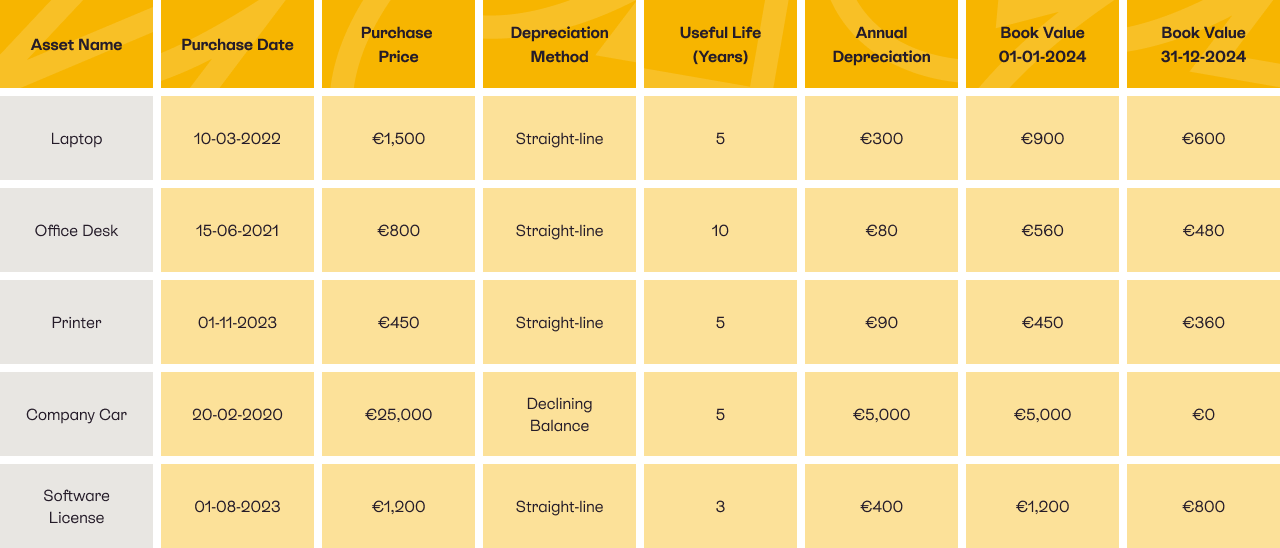
The depreciation method available depends on your country's accounting and tax rules. Dutch sole proprietors generally follow Dutch tax guidance issued by the Belastingdienst.
Freelancers based in the Netherlands but operating an Estonian company as an eResident follow Estonian accounting standards, which means the treatment may differ depending on the type of asset and the accounting policy adopted.
Dutch tax incentives for business investments
The Dutch tax system offers several tax benefits to entrepreneurs who invest in business assets. Some key deductions include:
🟢 Kleinschaligheidsinvesteringsaftrek (KIA) – Small-scale investment deduction for business purchases above €2,901 per year (2026).
🟢 Milieu-investeringsaftrek (MIA) – Deductions for environmentally friendly equipment.
🟢 Vervroegde afschrijving (Accelerated Depreciation) – Some assets can be fully depreciated earlier based on tax incentives.
❗The above deductions only apply to businesses eligible under Dutch tax legislation.

Managing Business Assets with Xolo Leap
Whether you're operating as a Dutch sole proprietor or running an Estonian company from the Netherlands, keeping accurate records of business assets makes accounting easier and helps ensure you're prepared for tax season.
Understanding depreciation is only one part of maintaining healthy business finances. Having the right accounting support means you spend less time worrying about compliance and more time growing your business.
With Xolo Leap, you can upload invoices for qualifying business purchases, keep supporting documentation organised and work with accountants who help ensure your company's accounts reflect business assets correctly.
Rather than manually maintaining spreadsheets, your accounting records stay organised throughout the year, making annual reporting significantly easier.
Sign up today and let Xolo make every tax season stress-free! 🚀